Friday, June 26, 2009

Beru Betto Official Website

Hi all, Beru Betto will be officially launching the new illustration website today.

Click here Beru Betto Official Website.

Here is a preview of the first post:


Go to Beru Betto Official Website for the full preview.

You can also now add Beru Betto to your favourite pages or Become a Fan on Facebook.

Enjoy : )


Tuesday, June 16, 2009

Beru Betto in Singapore Blog Awards 2009!


Hi everyone, I am so thrilled because Beru Betto is one of the TOP TEN finalists for 'Best Individual Blog' category!

Please vote for Beru Betto here:

http://sgblogawards.omy.sg/category/

1. Choose 'Best Individual blog' category.
2. Look for Beru Betto (scroll down to the last one).
3. Click VOTE.

Voting is from now till 31st July.

Oddly enough, they require everyone to have a Login account first before voting (top right hand corner to register). Hopefully it wouldn't be of too much trouble for you guys. Thanks so much for your support and participation : )


Thursday, May 14, 2009

NEW! (S) Box Boy Plant Holder Tutorial

Oh boy, the past few weeks were not so good for me. I've been very ill, but am now on the road to recovery and getting better each day. Thanks to this incident, I also stopped all work and went on a small self-pampering shopping spree. So I went and bought some pairs of shoes and other material delights and guess what, since I didn't have any use for the (S)hoeboxes, I figured out that I would use them for something else. So here is the (S) Box Boy tutorial that I've been dying to show you all.

(S) Box Boy is a (S)hoebox plant holder that you can use as a center display for your home, or simply place him in your garden like a cute garden display. There are infinite ways in which you can customize these (S) Box Boys. You can even make an army of it with different cutting edge designs. It all only depends on how many (S)hoeboxes you've got. See, what did I tell you guys about keeping your trash? Let's go eco : )

We will be needing:
1. (S)hoebox (preferably with a full lid)
2. Any outdoor/indoor potted plant that you like (I'm using a Cactus Leaf plant a.k.a. Goldfish Grass)
3. Plant holder/tray/plate
4. Cardboard (thick)
5. Acrylic paint
6. Brushes
7. Fabric/other materials (optional)
8. Penknife/ Scissors
9. Strong glue
10. Acrylic varnish (optional)
11. Downloaded (S) Box Boy Template

Click on the image below to get a high-res file of the (S) Box Boy template:

Now with the (S)hoebox and template, we start off by brainstorming how we want our (S) Box Boy to look like. Come up with a fantastic concept and colour palette, and also play around with other materials such as fabric and recycled materials. Once we've got that going, we measure out a diameter on the (S)hoebox lid that the potted plant can peek out through then cut a hole. Once we've done that, we can now start to paint the lid and the box with the acrylic paint.


Leave it to dry while we work on the next interesting bit. Print out two sheets of the downloaded body template. You can scale it to any size that you like, depending on the size of your (S)hoebox. I printed mine on an A4 paper, scaled to fit. Tape one sheet at a time on the thick cardboard so that you can cut it out nicely. Be extra careful with the curved arms. Once both that's done, measure out the depth of how 'fat/thin' you want your (S) Box Boy's body to be. Then measure and cut out rectangles to 'extrude' the body. Glue these on nicely.


Now for the curved arms, measure out the rectangle piece and score it with a penknife in equal widths. Give it a little bend. You'll see that the cardboard curves up nicely without any creases. Glue these on too, and then fix the other cut out body template on top.


Finally, after all the cutting and measuring, we can finally get to the best part of all. The painting and designing of your own (S) Box Boy! That is, after you've glued the (S) Box Boy's head and body together ; ) This is where I like to say: GET CREATIVE & EXPLORE. Just let your imagination go wild. Choose between simple and extreme, or go for both : ) This time I'm going for something simple and cute. I painted the body white and added a touch of pink flesh paint in two areas.

When you've finished customizing, coat with a varnish (optional), then place the potted plant into the (S)hoebox. Let the pot sit on a tray so that the excess water can drain off without spilling onto the box. Close the lid*.

After all the hard work, treat yourself to a cam-whoring session with your masterpiece. You can leave it out in the open concrete jungle.


Or standing in the comfort of your own home.


Whichever way you choose, I hope (S) Box Boy brings a smile to you every time you see it.

While searching for some inspiration, you might want to check out come of these cool dudes:
Shin Tanaka
Kidrobot DUNNY
Undoboy (Check out Super-Bastard box toy)
Dolly Oblong
Marshall Alexander
Cubeecraft
Sal Azad
Oh-Sheet
Jerom

Toodles! : )

*For gift ideas: Decorate the inside of the box with lovely items to surprise your friend.

--Contributors--
Andy
Pearly


Tuesday, March 17, 2009

Julie Alvarez's Version of the DIY Menu Bottle

I'm very happy to share with everyone this beautiful version of the DIY Menu Bottle that Julie Alvarez did sometime back in January 2009. She is a very talented crafter and photographer. It really thrills me to see others being inspired and coming up with their own great art. Lovely prints and fonts, Julie! Looking forward to see more of her works : )

Here's the link to the photo and her FLICKR page:
http://www.flickr.com/photos/juliealvarez/3194667302/

View the tutorial that inspired Julie Alvarez:
Do-It-Yourself Menu Bottle


Friday, March 6, 2009

Sneaker Customizing Tutorial (Part 2)

Hi everyone, thanks so much for your votes and comments in the previous tutorial : ) Based on the unanimous votes for the first design, I will be sharing with you a detailed Part 2 tutorial on how you can customize your own sneakers using the painting method. Get ready for the good stuff!

We will be needing:
1. Acetone
2. Plenty of cotton wool/balls
3. Plenty of Q-tips
4. Gloves
5. Glass container
6. Angelus Leather Paint (available at Turtle Feathers)
7. Various thin brushes
8. Liquitex Matte Varnish
9. A pair of sneakers (I chose a white based sneaker because most of the parts are left white)
10. Good music


But before we get to the REALLY good stuff, here's something crucial to do before we lay out those paint brushes. Firstly, we have to take off the paint and wax on the sneakers. This paint-stripping step allows us to have a new 'canvas' layer on the sneakers to work on, and the leather paint will stay on better. Dip the cotton balls into some acetone in a glass container(wear a pair of gloves before doing so). Start rubbing the cotton ball onto the waxy surface of the sneaker. Rub on the areas where you will be painting over. And rub it in hard until you can see the paint and wax coming off. Use Q-tips on tough to reach areas. A new suede-like layer will be revealed underneath. For white sneakers, a grayish layer should appear.

This tedious process can be a real pain and could last for a few days, but it will be worth every effort :)

Here's a good video tutorial on how to prep your kicks:

After many gruelling hours of painful finger and nail rubbing, we can finally move on to the REALLY fun part! Here's where we can take out that gorgeous drawing/sketch from the previous tutorial and do our thing. Following the mock-up in Photoshop, I lightly sketched out some areas with a pencil as a guide before I started painting. Then I used various thin brushes and painted every detail in very carefully. Remember to paint in thin coats. And also, have fun blending the colours : )

Once the painting is done, let the sneakers sit for about 24 to 48 hours before varnishing. This curing process allows the paint to sink into the leather. Varnish in thin coats with Liquitex Matte Varnish (leave 2 to 3 hours between each coat). There you have it, your very own customized kicks!

Now lace 'em up and run around! Enjoy : )


Meanwhile, here are some awesome links for you to check out:

Mark Ong (Check out the masking tip)
http://www.sneakerfreaker.com/feature/sneaker-customizing/

SEKURE-D
http://www.sneakerfreaker.com/feature/SEKURE-D-CUSTOM-SNEAKERS-GUIDE/

PimpMyKicks
http://pimpmykicks.com/

Kicks On Fire
http://www.kicksonfire.com/

Happy Pimping! : )

--Contributors--
Andy


Tuesday, January 6, 2009

Sneaker Customizing Tutorial (Part 1)

I'm a sneaker freak. I've always wanted to customize my own pair of sneakers that would carry my own style because I was so tired of the old boring ones on the shelf. Here is a two part tutorial that I am going to share with you guys, in hope that it will inspire you to create something new out of the ordinary.

I'll start off by introducing this fabulous book, Art & Sole: Contemporary Sneaker Art & Design. The book focuses on contemporary, cutting edge sneaker collaborations between artists and designers based on their individual style and medium, and also features top street cred brands like Nike and Converse. Very awesome book.
Once you've browsed through the good stuff, let your imagination loose and start sketching out the design for your sneaker. Think of a good concept that best carries out your personal art style. We want the design to be unique and not cliched. For this tutorial, I am going to use an ontographic sketch that I did a few years back. I scanned the image in and then traced out with Adobe Illustrator's vector tool. Once the tracing was done, I opened the vector file in Photoshop and filled in some colours.
Before we get excited about painting some shoes now, grab a template of a sneaker from here:

Official Sneaker Templates

Choose the sneaker that you will eventually be painting on. Now this is the part where we superimpose our design or sketches onto the sneaker digitally. Open the file in Photoshop (newer versions). Notice the masked layers. You can add your own colours on the different layers that constitute with each part of the sneaker. This allows us to play with different colour palettes quickly, and it also gives us a visual reference of how the final product might look like. The basic techniques that you will need for this part is masking, clipping and layer blending. Tweak to your liking until it feels right.

Alternatively, if you are not Photoshop savvy, you can sketch out the sneaker template free hand and superimpose your design on it to see how it would fit. Add some colours to check if your colour palette is looking good. Play around with the colours and placement of your design.

Here's how mine turned out:
I'll leave these open for comments and voting. Do let me know which design you all prefer : )

Meanwhile here's another kick ass site for your reference:

Sneaker Freaker

Stay tuned for Part 2, the more exciting part of this tutorial. I will also be sharing with you Mark Ong's sneaker painting techniques. So see you guys again in a few days time.

Cheers : )


Thursday, January 1, 2009

Do-It-Yourself 2009 Calendar

Happy 2009 everyone! : D

To kick start a good year ahead, I am going to share this calendar tutorial with you guys. So here goes:

I am going to recycle a cardboard box that was used for an electrical appliance packaging. Fortunately, this open box has 12 compartments (for 12 months) which we will be needing. And the best thing is, this box has other lovely small compartments that I can decorate with. So, keep your 'trash'. They'll come in handy one day.
Once you've found your perfect box to work on, draw out a concept of how you want the calendar to look. The concept for this tutorial is nature. Hence I've decided to use recycled and green materials that conjure up the idea of 'nature'. I will also be creating a simple yet adorable rag doll with moss sprouting out of its ears. This character will give a touch of humour to the final piece. Give yourself a few days to think through if neccessary. Ideas don't usually come in a split second. Rather, they develop overtime.

After all the brainstorming, prepare your materials. We will be needing:

1. A cardboard box with 12 compartments
2. Some dried decorative hay or moss
3. Carpet grass
4. Sticks
5. Strings (Brown)
6. White clay
7. Fabric
8. Cotton wool
9. Felt wool square (Black)
10. Sewing Kit / Sewing Machine
11. Construction paper
12. White glue
13. Paper clips
14. Nuts and bolts / Nails
15. Penknife
Stuff some decorative moss into the smaller compartments to create tiny bird nests. Roll the clay into small egg-shaped balls. Let dry then glue them into these nests. Next, cut out some carpet grass and stick onto the 'walls' of some compartments. If you're wondering how I managed to get the exact carpet size for this tricky shape, I actually reversed the box and traced out the irregular shape then used that as a template for the carpet grass.
Use your creative instincts to create a garden like landscape for along the rims or ledges of the box. I've glued lumps of moss on to make them look like grass platforms. Keep decorating until you are satisfied with the look of the grass-scape. Make some trees. Roll some hay into a ball and glue onto sticks. Let dry and glue the trees into the moss beds.
Here is how the box looks like at this stage:
Now for the calendar, grab any reliable 2009 calendar from the Internet etc. We will be needing the dates as reference. I am going to digitally create a new look for the calendar using Adobe Illustrator. Create a new A4 canvas. Divide it into 12 equal squares using the Ruler guide. Choose the fonts you want to use and copy the dates carefully from the reference material. You can highlight the important dates for that month and list them down on the footer.
Be creative. Play around with the layout and design. Once you are satisfied with the look, double check again. You don't want any wrong dates that will eventually confuse you : ) Now print out your masterpiece onto a piece of A4 construction paper. I've used a brown paper that will fit nicely into my nature theme. Cut out the 12 months squares.
Here's the interesting part. We are now going to 'fix' these 12 squares into the 12 compartments of the box. Used a penknife to indent two slits in each compartment. Take a brown string, wring through these slits from the back. Next, roll the monthly calendar outwards so that the name of the month can be seen from the outside. Place into the compartment and tie it up with the brown string. Repeat for the other calendar months.
Leave the January calendar untied. We will be showcasing this month's calendar on a fabric billboard swing. For the billboard, cut two slits on the cardboard box and fix a nut and bolt or nail into each slit. Tie brown strings around both nails and let the strings dangle. Measure and cut out a 9.5 cm piece of square fabric. Punch or cut out two holes at the top corners. Tie the dangling brown strings through the holes on the fabric. Then clip the January calendar onto the billboard fabric using a paper clip. There you have it, a swinging billboard calendar showcase.
Now for the rag doll feature. Sketch out a few adorable characters. From my sketches, I've decided to go with the one that looks like a rabbit rag doll. Think about how you want the finish of the rag doll to look like. Do you want a clean finish to it or leave it ragged and raw. Your decision will determine how you will be sewing the doll. For this tutorial, I am following a rough look for the whole concept, so I will be sewing with my hands. I am going to rely on my imperfect stitching to create a ragged look for the doll.
Firstly, fold the chosen fabric in two. Using freehand, draw out the head, body, hands and legs of the doll. Here's how you do the head of the doll in detail. Once you got the right shape, cut out the fabric and stitch it on the sides. Leave the top open. Once that's done, reverse the fabric inside out.
Fill in the cotton wool then stitch up the 'brain', leaving the ear holes open.
Stuff some decorative moss into the ears of the rabbit rag doll.
Use a hole puncher to punch out two small black eyes from the felt wool square. Stick the eyes on nicely. For the mouth, cut two short pieces of brown strings, curl it and stick on with glue. Use some bobby pins to hold these down while the glue dries.

Repeat this process for the other parts of the body. Here's how my rag doll looks like:
Sitting comfortably.
When the rag doll is finally done, pin it onto the frame of the cardboard box.

Tada! It's done! Phew!

Hang this up on your wall or leave it on a shelf. Enjoy : ) May the coming year ahead be a fruitful and meaningful one for everyone.

Cheers!

--Contributors--
Pearly


Thursday, December 25, 2008

Do-It-Yourself Menu Bottle

It's the holidays and what better way than to give your friends a home cooked feast for Christmas. Here is a very quick and simple tutorial on how you can use branches or twigs, some clay and a used glass bottle to create a special 'Menu Display' piece for the dining table.

We will be needing:
1. Dead branches or twigs
2. White clay
3. Used glass bottle (washed and cleaned dry)
4. Acrylic Paint (White or any colour that you prefer)
5. Permanent markers

Wash the branches and twigs then let dry under the sun. Once they are dry, give your artistic instincts a go at floral display. Stick some of your favourite twigs into the bottle and adjust until you are satisfied with the look of it. I've picked some different types and sizes of twigs, but only used the ones that I thought were more pretty to go with the bottle. So go on and try mixing and matching.

Now that we've chosen the perfect twigs, paint the glass bottle with the acrylic paint. Try using different colours, such as earth colours or a mix of warm colours. Get creative, but bear in mind the concept of what you are aiming to achieve. In this case, I've used white acrylic paint to balance with the earth tones of my home.

When the glass bottle is dry, put the twigs or branches back into the bottle. At this point, I've decided to decorate the twigs with some clay balls so that it would not look so bare. To make the clay balls, scoop a small amount of white clay and roll into little balls. Use a little water if the clay becomes too dry. Stick these clay balls onto the tips of the twigs or branches. Use a little white glue if you feel necessary. Let dry.

Delight your friends with a tantalizing menu written on a bottle. They will be very excited to see what's for lunch. Or dinner. Use permanent markers on the painted glass bottle. Be as creative as possible : ) Place your masterpiece on the dining table as a common menu and table display feature.

Here's what I've prepared for my friends.

Merry Christmas and a Happy New Year to you all : )

--Contributors--
Andy
Hui En


Sunday, December 21, 2008

Handmade Pledge


I took a handmade pledge today : )
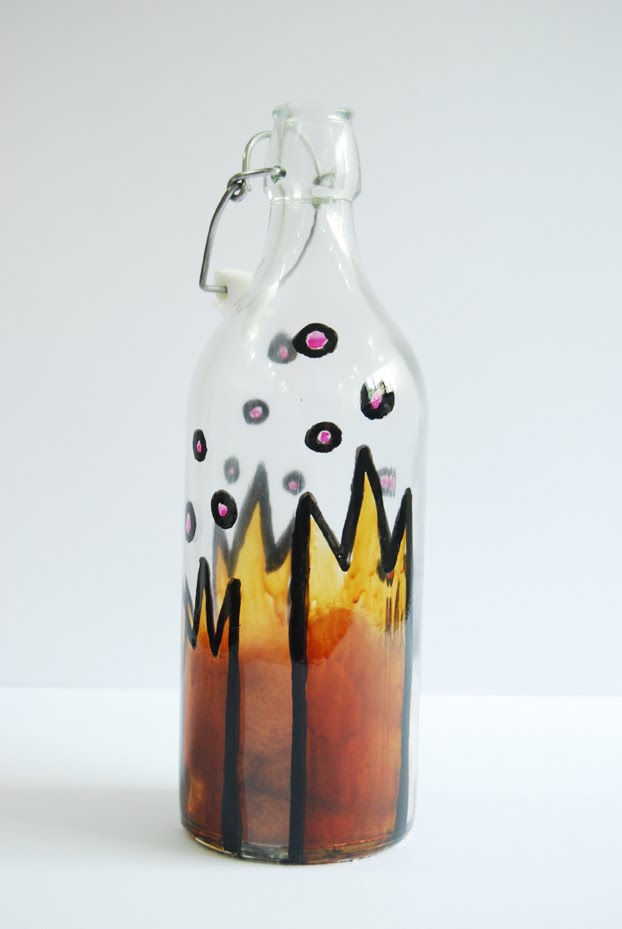
The cute Handmade Pledge on my side bar is done by Door Sixteen.


Thursday, December 18, 2008

Do-It-Yourself Mini Japanese Cyborg Monster Shelf

Ever wonder how many milk cartons you have used and thrown away? Here is an example of how you can recycle and turn these under-appreciated breakfast packaging into mini shelves using simple yet creative methods. Let your imagination run wild : )

Firstly, draw out a sketch of how you envision your mini shelf to look like. For this tutorial, I am going to draw out a little sketch of a cyborg monster looking carton. Sketching is a good way to give you a direction as you are building on the design of the shelf. Remember to date the sketch as this will let you recall when you did these wonderful doodles.

Now, prepare your materials. We will be needing:
1. Penknife
2. White Glue/UHU GLue
3. Acrylic Paint (Black & White)
4. Paint Brushes
5. Cloth
6. Ruler
7. Brown Strings
8. White Cardboard
9. A Bowl of Water
10. Black Marker
11. Transparent Plastic Tubes
12. Used Milk Carton (washed and dried)

Following the sketch as a rough guide, use a black marker to draw and cut out a rectangular hole from the milk carton for the 'mouth' of the monster. This hole will also be where the shelves are located.

After that, paint the whole milk carton using White arcylic paint. Let dry for a few minutes after the first coat then apply the second coat to cover the images and wordings on the box. Wait for the paint to dry. Acrylic paints dry rather quickly, so be careful not to let your brushes dry up with the paint. If they do, soak the brushes in turpentine, and you're all set.
While waiting for the paint to dry, we can start to make the Japanese 'Floor Mat' Shelving. Use a ruler to draw and measure out two 7x7cm squares on the cardboard. Cut these out with a penknife. Place some white glue or UHU glue on one cardboard square. Then gently wrap the brown strings around the cardboard in a repeated motion. Wrap until the whole cardboard is nicely covered up with the strings. There you have it, a DIY mini Japanese floor mat shelf. Repeat for the other cardboard to make two shelves.
Now that the white acrylic paint on the carton is dry, dip a thin brush into the black acrylic paint and paint out the hair and eyes of the monster. Don't worry if the paint goes off course. Let it dry then paint over with white acrylic again. If the acrylic paint gets too dry and lumpy, dilute it with only a few drops of water. Paint the milk carton cap black too. Then let dry.

Once everything is dry, cut out three 17cm long transparent plastic tubes. Glue the ends of the tubes onto the sides of the carton box to make the cyborg monster's mechanic like ears. Or hands.

Finally, glue the Japanese floor mat shelves into the hole of the carton box.
Tada! Now we have a Mini Japanese Cyborg Monster Shelf. You can now place your favourite miniature collections onto these shelves and decorate your walls and tables with these little adorable crafts. Want to share? Create your very own milk carton shelves and remember to leave a photo link in the comments or post photos of your creations at my Flickr Group:

http://www.flickr.com/groups/975243@N21/

Enjoy :D